Cricket Over Rate Calculator
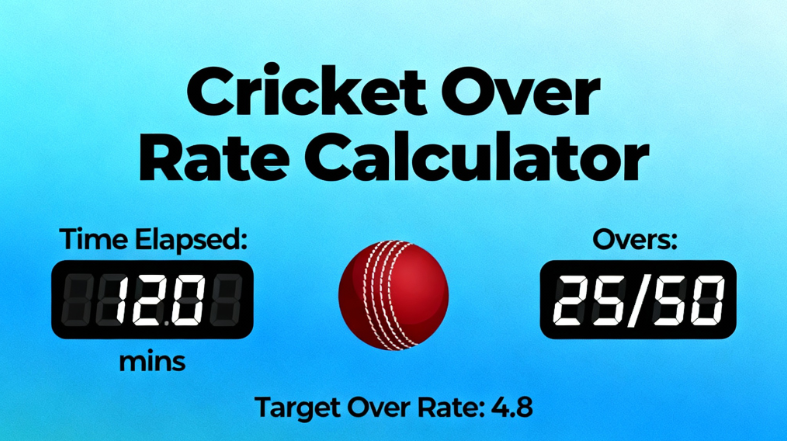
Cricket is as much about skill and tactics as it is about time management on the field. The Cricket Over Rate Calculator above helps players, coaches, and fans efficiently compute over rates—a crucial performance metric in modern cricket.
Table of Contents
What Is Cricket Over Rate?
Cricket over rate refers to the average number of overs bowled per hour by a fielding side. Maintaining a healthy over rate is required by governing bodies in all formats. Failing to do so can result in penalties, fines, or even point deductions in tournaments like the ICC World Test Championship.
How to Use the Cricket Over Rate Calculator
Using the Cricket Over Rate Calculator is simple and straightforward:
- Enter the total number of balls (legal deliveries) bowled by the team.
- Specify the total time (in minutes) spent bowling, excluding scheduled breaks.
- Add any extra time lost to breaks—such as injury stops, DRS reviews, or weather delays.
- Click the “Calculate Over Rate” button to instantly get the average number of overs bowled per hour along with an assessment based on international standards.
The Cricket Over Rate Calculator helps teams, coaches, and cricket enthusiasts quickly evaluate fielding pace and ensure compliance with ICC regulations.
Over Rate Requirements in Each Format
| Format | Minimum Over Rate | Typical Penalties for Slow Rate |
|---|---|---|
| Test Cricket | 15 overs/hour | Fines, point deduction, captain ban |
| ODI | 14.28 overs/hour | Fines, fielding restrictions |
| T20I | 14.11 overs/hour | Fines, fielding restrictions |
Teams falling short of minimums can face stiff sanctions, including match fee deductions and league point reductions.
How Is Over Rate Calculated?
Over Rate= Number of Overs Bowled /Total Hours of Play (without allowed breaks)
- One over = six legal deliveries.
- Adjustments are made for wickets (typically 2 minutes each), drinks breaks, injuries, DRS reviews, and other stoppages—these are deducted from the total time considered in the calculation.
- Over rates are monitored by match officials, who apply allowances as per governing body rules.
Example:
A team bowls 45 overs in 3 hours (excluding allowed interruptions).
Over Rate= 45 / 3 =15 overs/hourWhy Are Over Rates Important?
- Maintains Match Flow: Slow over rates disrupt the game’s rhythm, impacting player performance and spectator enjoyment.
- Tournament Integrity: In events like the ICC World Test Championship, penalties for slow rates can swing standings and determine finalists.
- Fairness: Ensures both batting and bowling sides have a fair opportunity within scheduled play time.
Real-Life Cricket Over Rate Drama That Shook the Championship
One of the most dramatic instances of over rate penalties impacting cricket happened during the 2020 ICC World Test Championship second Test between Australia and India.
- Australia was penalized 4 World Test Championship points for maintaining a slow over rate in that match.
- This deduction reduced their percentage of points won from 70% to 69.2%.
- As a result, Australia fell below New Zealand in the tournament standings and missed out on qualifying for the final.
- This was particularly controversial because Australia’s Runs Per Wicket Ratio was better than New Zealand’s.
- The penalty showed just how important over rate discipline is in elite cricket — it’s not just about winning the match on the field but also maintaining the game pace
Another Noteworthy Drama: England’s Over Rate Penalty at Lord’s 2025
- England was fined 10% of match fees and lost 2 World Test Championship points for falling short by two overs against India.
- This penalty dropped England from second to third place in the championship points table.
- The incident caused debate on fair penalty implementation in international cricket.
Frequently Asked Questions (FAQs)
Why do over rates differ for Tests, ODIs, and T20s?
Penalties include fines (a percentage of the match fee per over short), point deductions in leagues, and fielding restrictions. Persistent offenders—in particular captains—may also face suspensions.
Are breaks like DRS or injuries counted in the calculation?
No. Scheduled breaks, DRS reviews, injury stoppages, and some other interruptions are excluded when computing the over rate, ensuring teams aren’t unfairly penalized for unavoidable delays
How do I calculate allowed deductions?
Calculate all time loss for wickets, reviews, injuries, and breaks, then subtract this from the gross bowling time before using the calculator.
Helpful Reference Links
- ICC Rules on Over Rates (PDF)
- Wikipedia: Over rate
- Slow Over Rate Penalties Explained (YPLN Cricket)
- Go-To Cricket Guide: Youtube Explanation
Disclaimer
The Cricket Over Rate Calculator gives an indicative over rate for educational and recreational purposes. Actual calculations in official matches can change subject to match referee adjudication, local competition regulations, and other ICC or national governing body guidelines. In official disputes or events, always consult match officials and published cricket rules.
Cricket Stance provides fantasy cricket tips for entertainment purposes only. Participation in paid contests is for users 18+ and subject to local laws.


