If you are new to cricket, one question can feel confusing very quickly:
Why doesn’t one great bowler bowl all the overs?
If a team has a world-class fast bowler or mystery spinner, why not let them bowl every over and win the match?
The answer lies in maximum overs per bowler rules, one of cricket’s most important balancing laws.
These rules prevent one bowler from dominating the entire game. They ensure:
- Fairness between bat and ball
- Tactical captaincy decisions
- Use of multiple bowlers
- Variety in the contest
- Better entertainment for fans
Think of it like basketball rotations or football substitutions — teams must spread resources wisely.
This guide explains the maximum overs a bowler can deliver in Test cricket, ODI, T20, T10, The Hundred, and even rare or developmental formats.
Table of Contents
What Does “Maximum Overs Per Bowler” Mean?
It simply means:
A bowler can only bowl up to a certain number of overs in an innings, even if they are bowling brilliantly.
Once they hit that limit, they cannot bowl again in that innings.
Simple Example
Suppose a T20 innings has 20 overs.
A bowler can bowl a maximum of 4 overs.
So even if a bowler takes 4 wickets in their first 3 overs, they can bowl only one more over, not 10 or 15.
Easy Formula to Remember
Most limited-overs cricket follows a simple rule:
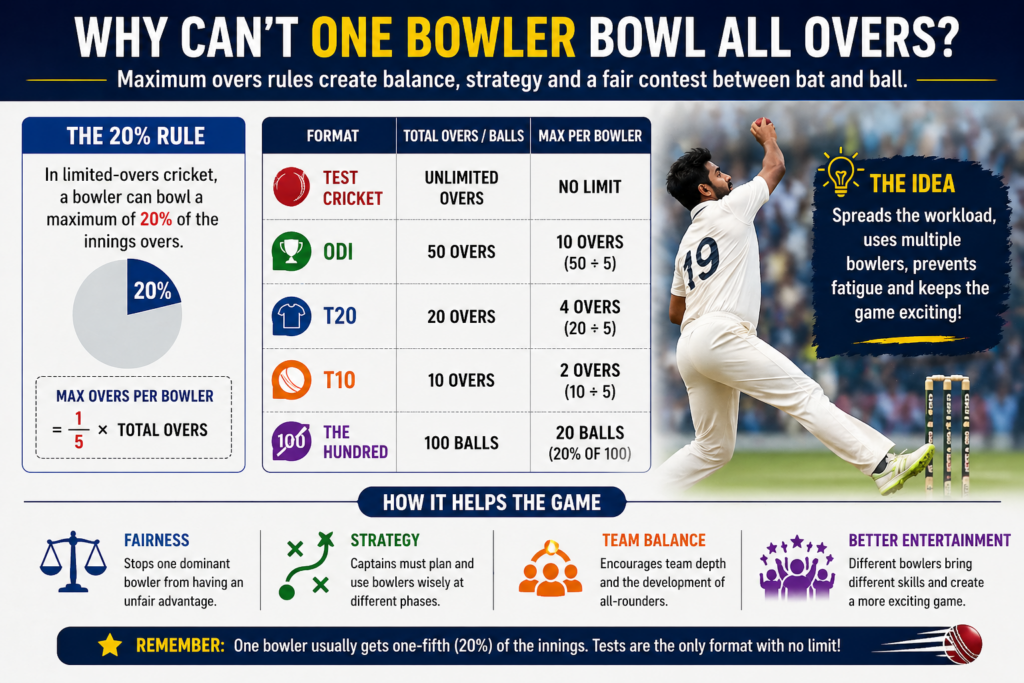
A bowler can bowl 20% of the innings overs.
Maximum Overs Per Bowler=51×Total Overs in Innings
Examples:
| Format | Innings Overs | Max per Bowler |
|---|---|---|
| ODI | 50 | 10 |
| T20 | 20 | 4 |
| T10 | 10 | 2 |
| 30-over match | 30 | 6 |
That 20% rule appears again and again.
Maximum Overs Per Bowler in Test Cricket
Rule:
There is no maximum overs limit for a bowler in Test cricket.
Yes — no cap at all.
A bowler can bowl:
- 5 overs
- 25 overs
- 40 overs
- Even 50+ overs in an innings
It depends on:
- Fitness
- Captain’s strategy
- Pitch conditions
- Match situation
Example
A spinner like Ravichandran Ashwin may bowl 35 overs in a day on a turning pitch.
A fast bowler like James Anderson may bowl long spells with the new ball.
No law stops them.
Why No Limit in Tests?
Because Test cricket is about endurance and tactics.
Captains can attack using their best bowlers as long as needed.
That makes Test cricket unique.
Visual Example
Imagine a 90-over day:
Bowler A — 28 overs
Bowler B — 22 overs
Bowler C — 18 overs
Bowler D — 15 overs
Part-timers — 7 overs
Completely legal.
Maximum Overs Per Bowler in ODI Cricket
Rule:
In a 50-over ODI:
One bowler can bowl maximum 10 overs.
10=550
Why 10 Overs?
Because 50 overs ÷ 5 = 10.
That means captains need at least five bowlers.
This is why teams cannot rely on only 2 or 3 stars.
Example
A team may use:
- Bowler 1 – 10 overs
- Bowler 2 – 10 overs
- Bowler 3 – 10 overs
- Bowler 4 – 10 overs
- Bowler 5 – 10 overs
50 overs completed.
What If a Bowler Is Taking Wickets?
Still stops at 10.
Even if someone has figures of:
10 overs
5 wickets
18 runs
They cannot bowl an 11th over.
Rule is absolute.
Rain-Reduced ODI Matches
This is where beginners get confused.
If rain reduces a match:
30-over innings
Maximum per bowler:
6=530
6 overs.
25-over innings
Maximum:
5 overs.
40-over innings
Maximum:
8 overs.
Same 20% rule.
Maximum Overs Per Bowler in T20 Cricket
Rule:
In T20:
A bowler can bowl maximum 4 overs.
4=520
Why This Matters
This rule shapes the entire game.
Captains decide:
- Who bowls Powerplay?
- Who bowls middle overs?
- Who bowls death overs?
Because only 4 overs are available per bowler.
Typical T20 Bowling Split
Bowler A — 4
Bowler B — 4
Bowler C — 4
Bowler D — 4
Bowler E — 4
Total = 20
Can a Bowler Bowl 4 Consecutive Overs?
Yes.
It is allowed.
But rare.
Captains usually spread them out.
Example:
Over 2
Over 6
Over 14
Over 19
Rain-Reduced T20
If reduced to 15 overs:
Maximum:
3 overs.
If reduced to 10 overs:
2 overs.
Maximum Overs Per Bowler in T10 Cricket
T10 is short and explosive.
Rule:
In a 10-over innings:
Each bowler can bowl maximum 2 overs.
2=510
This means captains need at least 5 bowlers again.
Very little room for error.
A bad over can change the match.
Example
2-2-2-2-2
All five bowlers complete quota.
Simple.
Maximum Overs Per Bowler in The Hundred
This format confuses many people because it uses balls, not overs.
A team faces 100 balls.
Rule:
A bowler may bowl:
- 20 balls maximum
That equals:
20 balls = 5 traditional overs? No.
Remember:
Traditional over = 6 balls.
So:
20 balls = 3 overs + 2 balls
But in The Hundred it is simply called 20 balls.
Extra Twist
A bowler may bowl:
- 5 balls
- 10 balls consecutively
That makes strategy unique.
Visual
100 balls total
Bowler A – 20 balls
Bowler B – 20 balls
Bowler C – 20 balls
Bowler D – 20 balls
Bowler E – 20 balls
100 complete.
Maximum Overs in 30-Over, 40-Over and Club Cricket
Many school, club and amateur games use reduced overs.
Use same formula:
20% rule
| Match Type | Max Per Bowler |
|---|---|
| 20 overs | 4 |
| 30 overs | 6 |
| 35 overs | 7 |
| 40 overs | 8 |
| 45 overs | 9 |
Very simple.
What Happens If a Team Has Only 4 Bowlers?
Problem.
Because they may not complete innings legally.
Example:
T20 requires 20 overs.
4 bowlers x 4 overs = 16.
Still 4 overs left.
Captain needs a fifth bowler.
This is why teams often use:
- Batting all-rounders
- Part-time spin
- Sixth bowling option
Why These Rules Exist

Without restrictions, imagine this:
A world-class bowler bowls all 20 T20 overs.
Batters would struggle.
Matches would become unfair.
Rules prevent that.
They ensure:
1. Balance
Batters get relief from facing one bowler forever.
2. Strategy
Captains must think.
Use best bowler early?
Save overs for death?
Big decisions.
3. Team Building
Teams need depth.
Not just one superstar.
4. Entertainment
Different bowling styles create variety:
- Pace
- Swing
- Spin
- Yorkers
- Bouncers
More fun to watch.
Famous Examples Where Overs Limits Hurt Teams
Sometimes captains wish rules didn’t exist.
A bowler dominates but finishes quota too early.
Then cannot bowl at death.
That has cost teams games.
This often happens in leagues like the Indian Premier League and tournaments like the ICC Cricket World Cup.
Example Scenario
Bowler has figures:
3 overs
3 wickets
9 runs
Captain uses fourth over in 14th over.
Now bowler unavailable at 20th over.
Opposition scores 25 in final over.
Match lost.
That is tactical risk.
Super Over Rules
New fans ask:
Does the same limit continue in a Super Over?
No.
Super Over is separate.
Usually:
One bowler bowls the entire Super Over.
Normal innings limits do not carry over.
Can Injured Bowlers Return?
Yes, if fit.
But maximum limits still apply.
A bowler who has completed quota cannot return.
10 overs in ODI means finished.
4 in T20 means finished.
No exceptions.
What About No-Balls and Wides?
Important detail.
A legal over requires 6 valid balls.
If a bowler bowls:
Wide
No-ball
Extra deliveries must be bowled.
But it still counts as part of that over.
Overs limit remains unchanged.
Can a Wicketkeeper Bowl?
Yes.
If laws allow and captain changes role.
Then that player can bowl too.
And their quota follows same rules.
Quick Format Summary
Test Cricket
Maximum overs per bowler:
Unlimited
ODI
Maximum:
10 overs
T20
Maximum:
4 overs
T10
Maximum:
2 overs
The Hundred
Maximum:
20 balls
30-Over Match
Maximum:
6 overs
40-Over Match
Maximum:
8 overs
Easy Way Beginners Can Remember It
Think:
One bowler usually gets one-fifth of innings.
20%.
Except Tests, where there is no cap.
That single idea explains almost all formats.
Cheat Sheet
Use this memory trick:
- 50 overs → 10
- 20 overs → 4
- 10 overs → 2
- 100 balls → 20 balls
- Tests → Unlimited
Easy.
Common Beginner Mistakes
“Can one bowler bowl all death overs?”
Only if those overs fit quota.
“Can a bowler bowl two overs in a row?”
Yes.
Allowed.
“Does maiden over give extra overs?”
No.
Still counts.
“Does taking wickets increase quota?”
No.
Quota never changes.
“Can captain break the rule in emergencies?”
No.
Rule is fixed.
How This Affects Fantasy Cricket
If you play fantasy contests, knowing overs limits matters.
A bowler can only earn points within quota.
Example:
A strike bowler in T20 has only 4 overs to take wickets.
A death bowler often has more wicket potential.
Understanding quota helps evaluate:
- Economy potential
- Wicket upside
- Captaincy picks
- Bowling roles
Huge edge.
Final Thoughts
The maximum overs per bowler rules may look technical, but they are actually simple once you know the pattern.
In most formats:
A bowler gets 20% of the innings.
51=20%
That means:
- ODI → 10 overs
- T20 → 4 overs
- T10 → 2 overs
- The Hundred → 20 balls
- Test cricket → no limit
These rules create balance, strategy, and drama — and they are a major reason cricket works as a sport.
If you are new to cricket, understanding this one rule helps you understand captaincy, bowling changes, and even fantasy strategy much better.
FAQ
How many overs can one bowler bowl in ODI?
A bowler can bowl a maximum of 10 overs in a 50-over ODI.
How many overs can one bowler bowl in T20?
A bowler can bowl maximum 4 overs.
Is there a maximum overs limit in Test cricket?
No. There is no overs limit in Test matches.
How many overs can a bowler bowl in T10?
Maximum 2 overs.
How many balls can a bowler bowl in The Hundred?
Maximum 20 balls.
Reference Links
- International Cricket Council (ICC) – Official Playing Conditions
International Cricket Council
Use for official ODI, T20I and Test bowling restrictions. - ICC Men’s ODI Playing Conditions (Clause on Maximum Overs Per Bowler)
https://www.icc-cricket.com/about/cricket/rules-and-regulations/playing-conditions - ICC Men’s T20I Playing Conditions
https://www.icc-cricket.com/about/cricket/rules-and-regulations/playing-conditions - Marylebone Cricket Club (MCC) Laws of Cricket
Marylebone Cricket Club
https://www.lords.org/mcc/the-laws-of-cricket - The Hundred Competition Rules (ECB)
England and Wales Cricket Board
https://www.ecb.co.uk/thehundred - T10 League Playing Conditions (Format Reference)
T10 League
https://www.t10league.com - Duckworth-Lewis-Stern (DLS) Method Explanation (for rain-reduced overs examples)
https://www.icc-cricket.com/news/icc-media-information-duckworth-lewis-stern
Disclaimer
Cricket playing conditions can vary slightly in domestic leagues, junior competitions or special tournament regulations. Always check official rules from the International Cricket Council or competition-specific playing conditions for match-specific exceptions.

