Cricket is a game of fine margins. Sometimes a single illegal delivery can change the outcome of an entire match. One such delivery is the no-ball.
If you have ever wondered what is a no ball rule in cricket, how a no ball works, or why umpires call no ball, this guide will explain everything in simple terms.
In this article, we will cover:
- What is a no-ball in cricket
- Why a no-ball is called
- All types of no-balls
- Free hit rule
- Batting and bowling consequences
- Real match examples
- FAQs about no-ball
Let’s begin.
Table of Contents
What Is a No Ball Rule in Cricket?
A no-ball is an illegal delivery bowled by the bowler.
When a no-ball is called:
- The batting team gets one extra run
- The ball does not count in the over
- The batsman cannot be dismissed in most ways
- In limited-overs cricket, the next ball is often a free hit
The umpire signals a no-ball by extending one arm horizontally.
Why Is the No-Ball Rule Important?
The no-ball rule exists to:
- Ensure fair play
- Prevent dangerous bowling
- Stop bowlers from gaining unfair advantage
- Protect batsmen
Without this rule, bowlers could bowl dangerously fast or unfairly overstep the crease.
1. Front Foot No-Ball (Overstepping)
This is the most common type of no-ball.
A front foot no-ball occurs when:
The bowler’s front foot lands beyond the popping crease while delivering the ball.
Key Points:
- Some part of the front foot must be behind the popping crease
- It can be in the air or on the ground
Example:
If the bowler steps too far forward and crosses the line, it becomes a no-ball.
Result:
- One extra run
- Free hit (in white-ball cricket)
2. Back Foot No-Ball
A back foot no-ball is called when:
The bowler’s back foot lands outside the return crease.
The back foot must land inside the return crease.
Why It Matters:
This rule ensures the bowler stays within the legal bowling area.
3. Waist-High Full Toss (Beamer)
A beamer is a delivery that:
Reaches the batsman above waist height without bouncing.
Conditions:
- If it is fast and dangerous, it is automatically a no-ball
- Repeated beamers can lead to warnings or bowler suspension
Example:
A fast full toss that reaches chest level = No-ball
4. Above-Shoulder High Full Toss (Any Speed)
Any full toss above shoulder height of the batsman (in normal stance) is:
- A no-ball, regardless of speed
This rule exists mainly for player safety.
5. Overhead Bouncer (Short-Pitched Ball)
A short ball is legal if it passes below head height.
But it becomes a no-ball if:
It passes above the batsman’s head while standing upright.
Additionally, there are limits on:
- Number of bouncers per over (varies by format)
6. Throwing (Chucking) No-Ball
A bowler must keep the arm straight.
If:
The elbow straightens more than the permitted limit,
It is considered an illegal action (throwing), which can result in:
- No-ball call
- Reporting of bowling action
7. Too Many Fielders Outside the Circle
In limited-overs cricket:
- Only a certain number of fielders are allowed outside the 30-yard circle
If the fielding team violates this:
The delivery is called a no-ball.
8. Underarm Bowling (Without Agreement)
Underarm bowling is legal only when:
- The batsman is informed in advance
If done without consent, it becomes a no-ball.
9. Bowler Breaking the Stumps While Delivering
If the bowler breaks the stumps with any part of the body during delivery:
- It is a no-ball
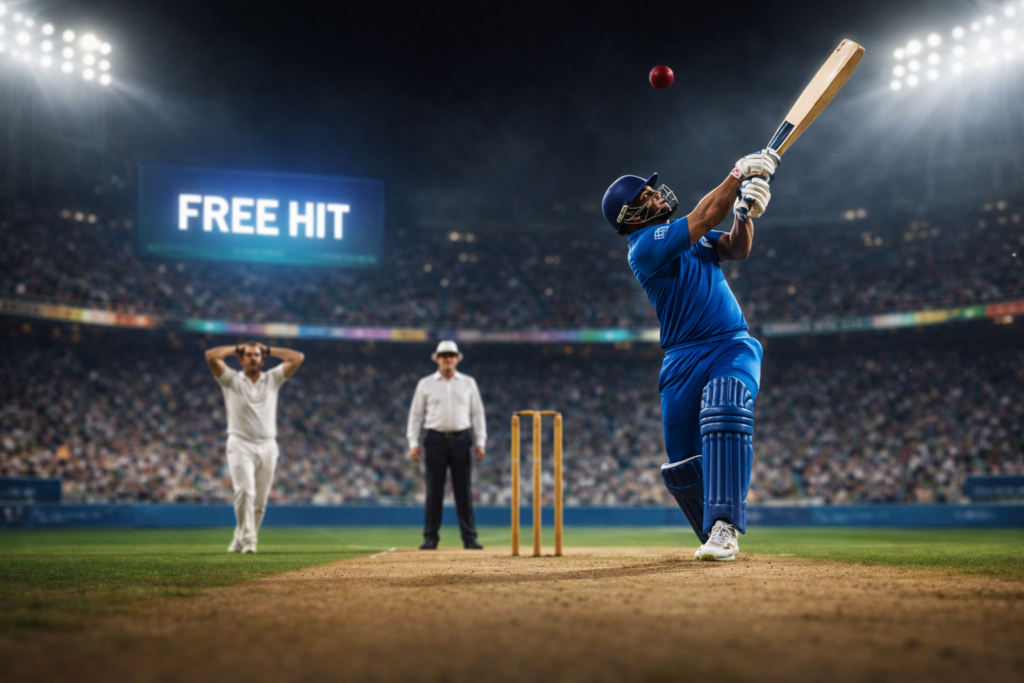
What Is a Free Hit?
A free hit is awarded after:
- Any front-foot no-ball
On a Free Hit:
The batsman can only be dismissed by:
- Run out
- Hit the ball twice
- Obstructing the field
They cannot be out:
- Bowled
- Caught
- LBW
- Stumped
- Hit wicket
Free hits increase scoring and excitement in limited-overs cricket.
- Loading relevant tools…
Can a Batsman Be Out on a No-Ball?
Yes, but only in certain ways:
Allowed dismissals:
- Run out
- Obstructing the field
- Hit the ball twice
Not allowed:
- Bowled
- Caught
- LBW
- Stumped
- Hit wicket
Does a No-Ball Count as a Ball?
No.
- It does not count in the over
- The bowler must re-bowl the delivery
Does the Batsman Get Runs from a No-Ball?
Yes.
The batting team receives:
- 1 run as penalty
- Plus any runs scored off the bat
- Plus byes or leg-byes
Example:
If a batsman hits a six off a no-ball → Total runs = 7
How Umpires Detect No-Balls Today
Modern cricket uses:
- On-field umpires
- Third umpire technology
- Front-foot no-ball monitoring systems
In many international matches, front-foot no-balls are checked automatically.
Difference Between No-Ball and Wide Ball
| Feature | No-Ball | Wide Ball |
|---|---|---|
| Illegal delivery | Yes | Yes |
| Extra run | Yes | Yes |
| Counts in over | No | No |
| Free hit | Yes (certain cases) | No |
| Caused by foot fault | Yes | No |
Famous No-Ball Moments in Cricket
- Lasith Malinga’s toe-crushing yorkers ruled no-ball
- Free hit sixes in IPL finals
- Close third-umpire decisions changing match outcomes
No-balls have influenced countless match results.
Why Bowlers Try to Avoid No-Balls
- Give free runs
- Offer free hits
- Increase pressure
- Ruin over rhythm
At professional level, even a single no-ball can cost a match.
Summary
The no ball rule in cricket exists to maintain fairness and safety.
A no-ball can be caused by:
- Overstepping
- High full toss
- Dangerous bouncer
- Illegal action
- Fielding violations
Understanding these rules makes watching cricket more enjoyable and helps players improve discipline.
Frequently Asked Questions (FAQ)
What is a no ball in cricket?
A no-ball is an illegal delivery that gives the batting team one extra run and an extra ball.
Does every no-ball give a free hit?
Only front-foot no-balls in limited-overs cricket give a free hit.
Can a batsman hit a six off a no-ball?
Yes. The runs count plus the no-ball extra.
Can a batsman be bowled on a no-ball?
No.
Is no-ball counted in over?
No. It must be re-bowled.
Who checks front foot no-balls?
In international cricket, the third umpire often checks using technology.
Reference Links
- MCC Laws of Cricket – No Ball (Law 21)
https://www.lords.org/mcc/the-laws-of-cricket-2d35b4b95a4a67ae8f9c76f258a84aa8/no-ball - MCC Laws of Cricket (Main Index – includes Law 21 No Ball)
https://www.lords.org/mcc/the-laws-of-cricket-2d35b4b95a4a67ae8f9c76f258a84aa8
📘 Informational Resources
- Wikipedia: No-ball in Cricket (overview and reasons)
https://en.wikipedia.org/wiki/No-ball - Wikipedia: Free hit rule explained
https://en.wikipedia.org/wiki/Free_hit
📘 Additional Helpful Guides
- Detailed No Ball Rules & Types Explanation
https://sportrulez.com/no-ball-rules-in-cricket/
Disclaimer
This article is for educational and informational purposes only. Cricket laws may be updated by governing bodies from time to time. Always refer to official ICC and MCC law books for the most current rules.

