Cricket Venue Analyzer — search a venue and explore historical stats
Venue Analyzer
Search any cricket ground for historical performance data
Search for a venue to explore its stats
Analyzing venue data…
Cricket Venue Analysis: Complete Guide to Understanding Cricket Ground Statistics and Pitch Reports
Introduction
In modern cricket, venue analysis has become one of the most important aspects of match preparation. Whether you are a fantasy cricket player, cricket analyst, bettor, coach, or simply a passionate fan, understanding how a cricket ground behaves can significantly improve your decision-making.
Every cricket stadium has unique characteristics. Some venues favor batters with flat pitches and short boundaries, while others help bowlers through swing, seam movement, or spin. Historical statistics often reveal patterns that can help predict how future matches might unfold.
Our Cricket Venue Analyzer helps users quickly access venue-specific data, including average scores, batting-first success rates, chasing records, pitch behavior, toss trends, top-performing players, and recent match results. By studying these insights, users can make more informed decisions before a match begins.
This guide explains how cricket venue analysis works, why it matters, and how to use venue statistics effectively.
Table of Contents
What is Cricket Venue Analysis?
Cricket Venue Analysis refers to the process of studying historical data and pitch conditions at a specific cricket ground to identify patterns that influence match outcomes.
The analysis typically includes:
- Average first innings score
- Average second innings score
- Batting-friendly or bowling-friendly pitch
- Toss impact
- Win percentage while batting first
- Win percentage while chasing
- Boundary dimensions
- Recent scoring trends
- Performance of batters and bowlers
By combining these factors, users can estimate how a match is likely to progress.
Why Venue Analysis Matters in Cricket
Many cricket matches are decided by venue conditions rather than team strength alone.
For example:
- A strong batting team may struggle on a spin-friendly pitch.
- Fast bowlers often dominate on green pitches.
- Dew can significantly help chasing teams in night matches.
- Large grounds reduce boundary-scoring opportunities.
Venue analysis helps identify these hidden advantages and disadvantages before the match starts.
Benefits include:
Better Fantasy Team Selection
Players who perform well at certain venues often continue their success there.
Improved Match Predictions
Ground statistics can reveal whether batting first or chasing is generally more successful.
Understanding Pitch Behavior
Knowing whether a pitch assists batters, pacers, or spinners can improve pre-match analysis.
Enhanced Cricket Knowledge
Venue analysis provides deeper insight into why teams use specific strategies during matches.
Key Metrics Used in Cricket Venue Analysis
Average Score
Average score indicates how many runs teams typically score at a venue.
Higher averages suggest batting-friendly conditions.
Examples:
- Average score above 180 in T20 cricket indicates a batting paradise.
- Average score below 150 generally indicates bowling assistance.
Highest Score
The highest score provides insight into the venue’s scoring potential.
Grounds with extremely high scores usually have:
- Flat pitches
- Short boundaries
- Fast outfields
Lowest Score
Low scores often indicate:
- Difficult batting conditions
- Swing-friendly environments
- Spin-friendly surfaces
- Pressure situations
Matches Played
A larger sample size generally makes venue statistics more reliable.
Understanding Pitch Report Analysis
Pitch reports play a major role in cricket venue analysis.
Batting-Friendly Pitch
Characteristics:
- Good bounce
- Consistent pace
- Minimal movement
Advantages:
- High scoring matches
- Better stroke play
- Strong batting performances
Examples include several flat tracks used in limited-overs cricket.
Bowling-Friendly Pitch
Characteristics:
- Swing movement
- Seam assistance
- Uneven bounce
Advantages:
- Fast bowlers dominate
- Lower scores
- Challenging batting conditions
Spin-Friendly Pitch
Characteristics:
- Dry surface
- Cracks developing later
- Turn available
Advantages:
- Spinners become dangerous
- Batting becomes harder as the match progresses
Balanced Pitch
Characteristics:
- Assistance for both batters and bowlers
Balanced pitches usually produce competitive cricket and exciting contests.
Importance of Toss Records
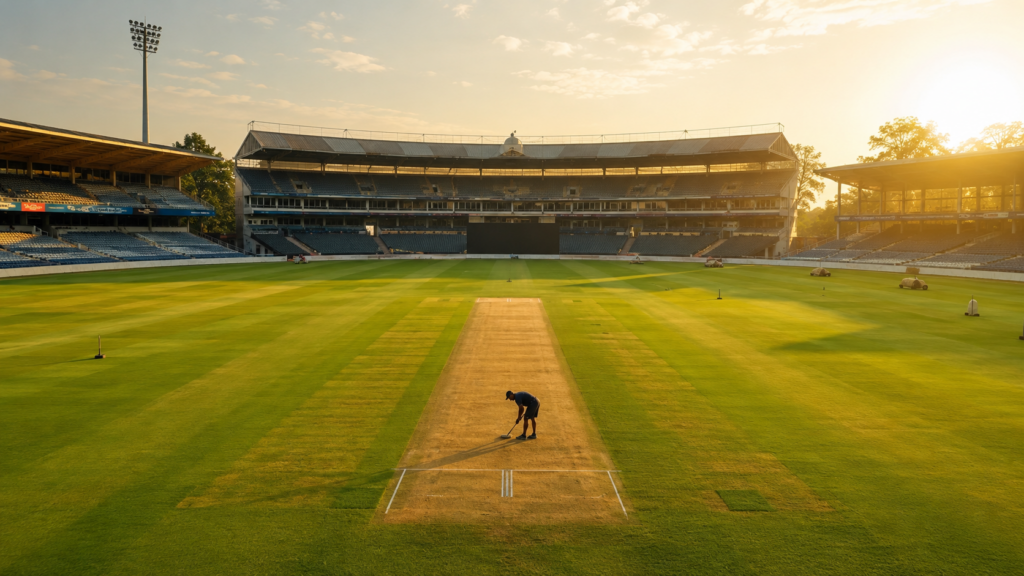
Many users ignore toss statistics, but they often reveal critical venue trends.
Questions to consider:
- Does batting first provide an advantage?
- Is chasing easier?
- Does dew affect evening matches?
- Does the pitch deteriorate later?
At some venues:
- Teams prefer batting first because pitches slow down.
- Teams prefer chasing because dew improves batting conditions.
Toss records help answer these questions.
Batting First vs Chasing Analysis
One of the most valuable venue statistics is comparing batting-first wins and chasing wins.
Batting First Advantage
Often seen when:
- Pitch deteriorates later
- Spin becomes stronger
- Pressure affects chasing teams
Chasing Advantage
Usually occurs when:
- Dew arrives
- Pitch remains consistent
- Boundaries are small
Studying historical data helps determine which strategy is more successful.
How Fantasy Cricket Players Use Venue Analysis
Fantasy cricket experts heavily rely on venue data.
Selecting Batters
Choose batters when:
- Venue average score is high
- Pitch favors stroke play
- Boundaries are short
Selecting Bowlers
Choose bowlers when:
- Pitch supports pace or spin
- Historical scores are lower
- Wickets fall regularly
Choosing Captain and Vice-Captain
Venue-specific performers often become reliable captaincy options.
Historical venue success can provide valuable clues.
How Bettors and Analysts Use Cricket Ground Stats
Professional analysts use venue statistics to evaluate:
- Match winner markets
- Total runs markets
- Player performance markets
- Highest innings score markets
Venue trends provide an additional layer of insight beyond team strength.
Steps to Use This Cricket Venue Analyzer
Step 1: Open the Venue Analyzer
Access the calculator above on this page.
Step 2: Search for a Venue
Enter the stadium name in the search box.
Examples:
- Wankhede Stadium
- Eden Gardens
- Lord’s Cricket Ground
- Melbourne Cricket Ground
Step 3: Select Match Format
Choose:
- T20
- ODI
- Test
- All Formats
Step 4: Review Venue Statistics
Analyze:
- Matches played
- Average score
- Highest score
- Lowest score
Step 5: Check Pitch Type
Identify whether the venue is:
- Batting-friendly
- Bowling-friendly
- Balanced
Step 6: Study Toss Trends
Review batting-first and chasing success rates.
Step 7: Analyze Recent Matches
Look at recent results to identify changing trends.
Step 8: Review Top Performers
Check leading batters and bowlers at the venue.
Step 9: Use Insights for Predictions
Combine venue data with team form and player performance.
Example 1: T20 Match at Wankhede Stadium
Suppose Mumbai Indians are playing Chennai Super Kings.
Venue analysis reveals:
- Balanced pitch
- Chasing teams perform well
- High-scoring conditions
- Dew factor present
Prediction insight:
- Toss-winning captain may choose to field first.
- Power hitters become valuable fantasy picks.
Example 2: Test Match at Lord’s
Venue analysis shows:
- Bowling-friendly conditions
- Strong seam movement
- Batting-first advantage
Prediction insight:
- Fast bowlers become premium selections.
- First innings performance becomes crucial.
Common Mistakes During Venue Analysis
Relying Only on Historical Data
Recent pitch behavior can differ from long-term trends.
Ignoring Weather Conditions
Rain, humidity, and cloud cover can significantly affect matches.
Ignoring Team Composition
Venue advantage matters less if a team lacks suitable players.
Overvaluing Toss Statistics
Toss trends should support analysis rather than drive it completely.
Best Practices for Accurate Cricket Venue Analysis
Follow these guidelines:
- Study recent venue matches.
- Check current pitch reports.
- Analyze weather forecasts.
- Compare batting and bowling strengths.
- Review toss history.
- Consider match format.
- Monitor team combinations.
Combining these factors produces more reliable predictions.
Future of Cricket Ground Statistics
Technology continues to improve cricket analytics.
Modern venue analysis increasingly includes:
- Ball tracking
- Pitch mapping
- AI-powered predictions
- Player matchup analysis
- Real-time performance models
These innovations are helping analysts make increasingly accurate predictions.

Frequently Asked Questions
What is a Cricket Venue Analyzer?
A Cricket Venue Analyzer is a tool that provides historical ground statistics, pitch reports, average scores, toss trends, and venue-specific performance data.
Why is venue analysis important?
Venue analysis helps users understand conditions that influence scoring patterns and match outcomes.
Can venue analysis improve fantasy cricket teams?
Yes. Venue-specific insights can help identify suitable batters, bowlers, captains, and vice-captains.
Are pitch reports always accurate?
Pitch reports provide useful guidance, but weather and match-day conditions can still affect outcomes.
Which is more important: team form or venue analysis?
Both are important. The best predictions combine team form, player performance, and venue statistics.
Does venue analysis work for all formats?
Yes. It is useful for T20, ODI, and Test cricket, although the factors affecting each format differ.
Reference Links
- International Cricket Council (ICC)
- ESPNcricinfo Stats Database
- Wisden Cricket Almanack
- Cricket Archive
Disclaimer
The Cricket Venue Analyzer is designed for informational and analytical purposes only. Historical venue statistics, pitch reports, and match trends do not guarantee future outcomes. Cricket matches are influenced by multiple factors including player form, weather conditions, team strategy, injuries, and match situations. Users should combine venue analysis with other research before making fantasy cricket selections, betting decisions, or match predictions.


