Cricket is filled with fascinating tactics, but few decisions influence the outcome of a Test match as dramatically as a declaration. A captain can spend hours building a dominant position only to make one crucial call that changes the entire match. That call is known as declaring an innings.
For many new cricket fans, declaration rules can seem confusing. Why would a team voluntarily stop batting when they still have wickets in hand? Why do captains declare at different scores? How do declaration decisions affect match results?
Understanding the Declaration Rules in Test Cricket is essential for appreciating the strategic depth that makes Test cricket unique. Unlike limited-overs formats, Test cricket allows teams to shape the game through tactical declarations that create opportunities to force a result.
In this comprehensive guide, we’ll explore what declarations are, why they matter, how captains use them strategically, and some of the most famous declarations in cricket history.
Table of Contents
What is Declaration Rules in Test Cricket?
Featured Snippet Definition Box
Declaration in Test cricket is the act of a batting captain voluntarily ending their team’s innings before all 10 wickets have fallen, with the objective of giving their bowlers enough time to dismiss the opposition and achieve a result.
The declaration rule exists only in multi-day cricket formats such as Test matches and first-class cricket. It does not apply in One Day Internationals (ODIs), T20 Internationals, or franchise T20 leagues.
A captain may declare an innings closed at any point during their team’s innings, provided strategic conditions favor doing so.
Understanding the Concept of a Declaration

At first glance, declaring an innings appears unusual.
Imagine a team batting at 450/5. Most sports encourage scoring as many points as possible. However, Test cricket is different because time plays a crucial role.
A captain must balance two competing objectives:
- Score enough runs to create a winning position.
- Leave enough time to dismiss the opposition twice.
If a team bats for too long, they may build a huge lead but run out of time to bowl the opposition out. As a result, the match may end in a draw.
Therefore, declarations become a critical strategic tool.
Why It Matters
Declarations often determine whether a Test match ends in:
- Victory
- Defeat
- Draw
Without declarations, teams could simply continue batting indefinitely, reducing the chances of a result.
The declaration rule helps maintain competitive balance by encouraging captains to make calculated decisions.
In modern Test cricket, aggressive declarations are increasingly common because teams prioritize winning over merely avoiding defeat.
Several successful teams, including Australia, England, and India, have regularly used bold declarations to force victories.
Key Benefits
Declaring an innings provides several advantages.
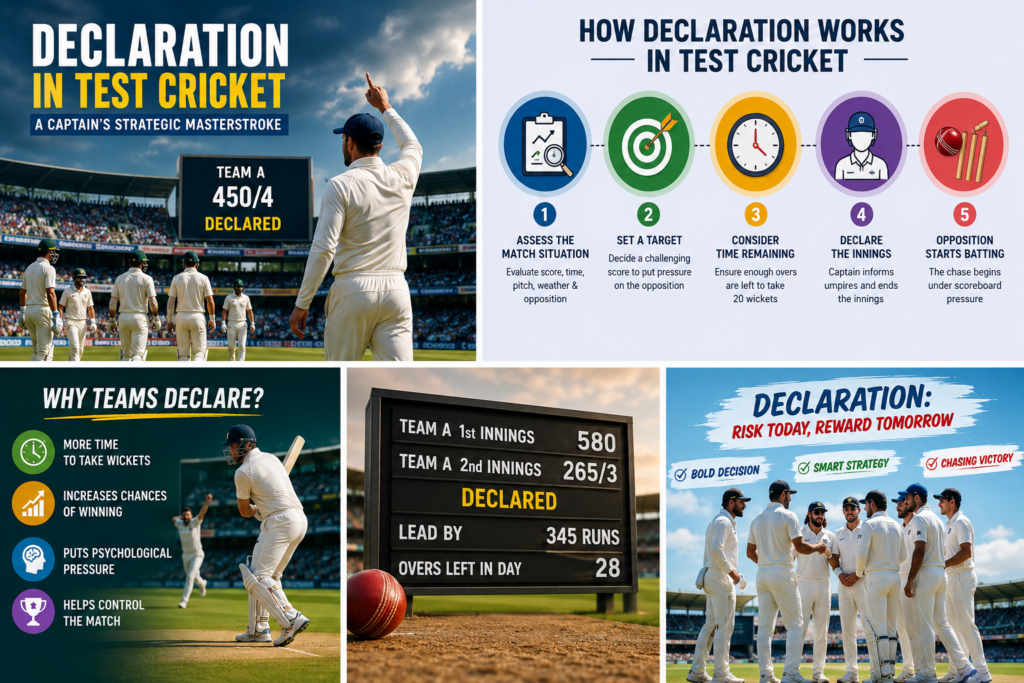
1. Creates Time to Take Wickets
The primary purpose is to give bowlers sufficient time to dismiss the opposition.
2. Increases Winning Chances
A timely declaration often converts a potential draw into a possible win.
3. Applies Psychological Pressure
A large target combined with limited time can create immense pressure on the opposition.
4. Controls Match Momentum
Captains can dictate the pace and direction of the game.
5. Forces Opponents Into Mistakes
Teams chasing challenging targets often lose wickets while attempting to score quickly.
Official Declaration Rules in Test Cricket
The declaration rule is governed by the official laws administered by the governing body of international cricket, the International Cricket Council and the Marylebone Cricket Club.
Key Declaration Rules
| Rule | Explanation |
|---|---|
| Captain’s Authority | Only the batting captain can declare |
| Voluntary Decision | Declaration is entirely optional |
| Before All Out | Team may declare before losing all wickets |
| Irreversible Action | Once declared, the innings cannot resume |
| Applicable Formats | Test and First-Class cricket only |
| Any Stage Allowed | Captain may declare at virtually any point |
These rules give captains significant flexibility in managing match situations.
Step-by-Step Guide
How Does a Declaration Work?
Step 1: Assess the Match Situation
The captain evaluates:
- Current score
- Lead size
- Remaining overs
- Pitch conditions
- Weather forecast
Step 2: Calculate a Safe Target
The captain estimates what score would make chasing difficult.
Step 3: Consider Time Remaining
Time is often more important than runs.
Step 4: Declare the Innings
The captain informs the umpires that the innings is closed.
Step 5: Opposition Begins Batting
The opposing team starts its innings with the declared target in mind.
Practical Examples
Scenario 1: Aggressive Declaration
Team A scores:
- First innings: 500
- Second innings: 250/4
Lead: 420 runs
Two sessions remain.
The captain declares at 250/4 to maximize bowling time.
Scenario 2: Conservative Declaration
Team A leads by 250 runs.
Only one session remains.
The captain chooses to bat longer because the target is not yet challenging enough.
Scenario 3: Weather Threat
Rain is forecast for the final day.
The captain declares earlier than usual to create additional bowling opportunities before weather interruptions.
Famous Declarations in Cricket History

Several declarations have become legendary because of their boldness.
Michael Clarke’s Declaration
Michael Clarke often favored attacking declarations, prioritizing victory over safety.
Ben Stokes and Bazball
Under the leadership of Ben Stokes, England has embraced highly aggressive declarations designed to produce results rather than draws.
India’s Tactical Declarations
Teams led by Virat Kohli frequently used proactive declarations to push for victories both at home and overseas.
These examples demonstrate how declarations reflect a team’s philosophy.
Comparison Table: Aggressive vs Conservative Declaration
| Factor | Aggressive Declaration | Conservative Declaration |
|---|---|---|
| Runs Scored | Fewer | More |
| Time for Bowlers | Greater | Lesser |
| Risk Level | Higher | Lower |
| Chance of Victory | Higher | Moderate |
| Chance of Draw | Lower | Higher |
| Psychological Pressure | Strong | Moderate |
Captains constantly weigh these factors before making their decision.
Common Challenges
Declaring is not as simple as it appears.
Captains face several challenges:
Predicting Pitch Behavior
A flat pitch may make batting easier than expected.
Weather Uncertainty
Rain can reduce available bowling time.
Opposition Strength
Strong batting lineups may comfortably survive.
Match Context
Series standings often influence declaration decisions.
Team Confidence
A captain must trust the bowling attack to capitalize on the declaration.
Best Practices
Successful captains generally follow certain principles.
Understand Pitch Conditions
The condition of the wicket significantly affects declaration timing.
Monitor Weather Closely
Weather forecasts can change declaration strategy.
Use Data and Analytics
Modern teams increasingly use predictive models.
Consider Opposition Weaknesses
Target specific vulnerabilities.
Prioritize Results
When circumstances permit, captains should seek victory rather than settle for a draw.
Common Mistakes to Avoid
Declaring Too Late
The most common error.
Too many runs can leave insufficient time.
Declaring Too Early
An inadequate target can give the opposition a realistic chance of winning.
Ignoring Weather
Unexpected rain frequently ruins carefully planned declarations.
Underestimating Opposition
Strong batting sides can survive difficult situations.
Emotional Decision-Making
Declarations should be based on strategy rather than instinct alone.
Expert Tips
Experienced analysts often recommend:
- Think in overs rather than hours.
- Consider wicket-taking opportunities.
- Study historical results at the venue.
- Use bowling strength as the primary guide.
- Factor in deteriorating pitch conditions.
- Plan declarations several sessions ahead.
- Keep scoreboard pressure in mind.
- Be willing to take calculated risks.
One observation from modern Test cricket is that successful teams often declare earlier than conventional wisdom suggests. Teams seeking consistent victories recognize that wickets require time, and time is the most valuable resource in a Test match.
Frequently Asked Questions
What is a declaration in Test cricket?
A declaration occurs when a batting captain voluntarily closes their team’s innings before all wickets have fallen.
Can a captain declare at any score?
Yes. A captain may declare at virtually any score, although strategic considerations usually determine the timing.
Can a declaration be reversed?
No. Once declared that the innings is permanently closed.
Why would a team stop batting voluntarily?
The objective is to create enough time to dismiss the opposition and secure victory.
Are declarations allowed in ODI cricket?
No. Declarations apply only in Test and first-class cricket.
Who decides when to declare?
The batting captain makes the decision, often after consulting coaches and senior players.
What happens after a declaration?
The batting innings ends immediately, and the opposition begins its innings.
What is the biggest risk of declaring?
Declaring too early may leave a target that the opposition can successfully chase.
Do weather conditions affect declaration decisions?
Yes. Rain forecasts frequently influence declaration timing.
What is an aggressive declaration?
An aggressive declaration sacrifices additional runs in exchange for more time to take wickets.
Final Thoughts
The Declaration Rules in Test Cricket represent one of the sport’s most fascinating strategic elements. While the rules themselves are relatively straightforward, the decision-making behind declarations requires a deep understanding of match conditions, opposition strengths, weather forecasts, pitch behavior, and risk management.
The best captains recognize that Test cricket is not merely about scoring runs. It is about creating opportunities to win. A well-timed declaration can transform a routine match into a thrilling contest, while a poorly timed one can allow victory to slip away.
As modern cricket continues to evolve toward more attacking styles of play, declarations remain a crucial weapon in a captain’s tactical arsenal. Understanding them provides fans with a richer appreciation of the strategy, calculation, and drama that make Test cricket unique.
References
- International Cricket Council (ICC)
URL: https://www.icc-cricket.com - Marylebone Cricket Club (MCC) – Laws of Cricket
URL: https://www.lords.org/mcc/the-laws-of-cricket - ESPN Cricinfo
URL: https://www.espncricinfo.com - Wisden Cricket
URL: https://wisden.com - BBC Sport Cricket
URL: https://www.bbc.com/sport/cricket - Cricket Australia
URL: https://www.cricketaustralia.com.au - England and Wales Cricket Board (ECB)
URL: https://www.ecb.co.uk - Board of Control for Cricket in India (BCCI)
URL: https://www.bcci.tv
Disclaimer
Educational Disclaimer
This article is intended for educational and informational purposes only. Cricket laws, playing conditions, and competition-specific regulations may be updated periodically by governing bodies such as the ICC and MCC. Readers should consult the latest official laws and playing conditions for the most accurate and current information. The examples and scenarios discussed in this article are illustrative and may not reflect every possible match situation.


